
What Does “High Risk” Actually Mean in Pregnancy?
BY: REBECCA BELENKY, Birth and Postpartum Doula at LOS ANGELES BIRTH
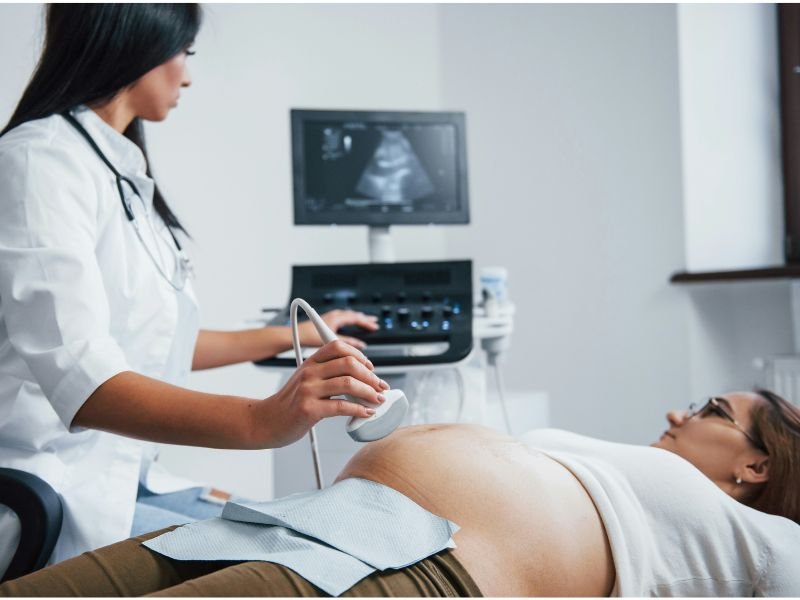
Pregnant person getting an ultrasound
I recently interviewed with a woman who was in the second trimester of her pregnancy looking for a birth doula. As we opened our conversation, she shared the shorthand version of her pregnancy with me: she and her husband were expecting their first baby, she was planning to give birth at Huntington Hospital in Pasadena, she told me the name of her doctor, and that she was high risk.
As we continued talking, I learned more of the story behind each of those details. But the part of her introduction that stuck with me was those two words: high risk.
I hear this label quite a lot. It comes up in meetings with clients, in pregnancy and postpartum support groups, and, of course, in conversations between pregnant people and their OBs and midwives.
What I have observed is that once someone receives the high-risk label, it can be very difficult to shake off—not only medically, but emotionally.
But what does "high risk" actually mean? And if you have been given this label, how can you understand what it means for your particular pregnancy without spending the next several months feeling like something bad is about to happen?
I'm not suggesting that we ignore risk or pretend complications can't happen. I'm suggesting that we look more deeply at what a risk factor actually means for an individual pregnancy—and how we can make informed decisions without allowing two words on a medical chart to define the entire experience.
What Qualifies a Pregnancy as “High Risk?”
According to Cleveland Clinic, a pregnancy is considered high risk when the pregnant person, the fetus, or both have a higher-than-average chance of experiencing a pregnancy complication.
I think the phrase “higher than average” is worth paying attention to.
All pregnancies carry some amount of risk. Pregnancy and birth are physiological processes, but they are not risk-free processes. Being given the high-risk label doesn't necessarily mean something bad is happening. It means there is a factor—or combination of factors—that may increase the possibility of a complication and may warrant additional attention, monitoring, or care. Within the pool of people with complicated pregnancies, a small chunk of them will be considered high risk.
Some enter pregnancy with a preexisting health condition, such as high blood pressure, diabetes, thyroid or kidney disease, a blood-clotting disorder, fibroids, or certain autoimmune diseases.
Others develop a condition or complication during pregnancy, such as gestational diabetes or gestational hypertension. There may be multiples or concerns involving the placenta, amniotic fluid, or the baby's growth and development.
Other risk factors may include certain prescription medications, environmental exposures, substance use, or infections.
Each of these carries its own particular considerations—which is one reason the broad label "high risk" can sometimes tell us surprisingly little about an individual person's pregnancy.
And then there is another factor I hear about all the time in my work with pregnant people: Age.
Are You High Risk—or Do You Have a Risk Factor?
There is something about the language of "high risk" that has always struck me as a little strange. Why do we describe the person this way?
When I hear someone described as a "high-risk person," I imagine someone who likes to skydive on the weekends, drives 100 miles per hour on a mountain road, or bets their life savings in Vegas.
But in pregnancy, we routinely take someone who may have one or more identifiable risk factors and give the entire person—and sometimes their entire pregnancy—the label HIGH RISK.
I think there is a meaningful difference between saying:
"You are high risk." and: "There is a risk factor in your pregnancy that we should pay attention to."
One describes you. The other describes something we know about your pregnancy.
That subtle difference matters because labels have a way of becoming identities.
"I'm high risk" can begin to feel like a permanent state of being rather than medical shorthand for a pregnancy that may benefit from additional attention.
But that shorthand leaves out a tremendous amount of nuance. A risk might be small or significant. It might be something already happening or something your care team is simply watching for. It might stay constant, increase, or decrease as your pregnancy progresses.
Understanding those distinctions may be far more useful than the label itself.
When Age Becomes a Risk Factor
For many pregnant people, the first time they hear themselves described as "high risk" has nothing to do with a disease or complication.
They are healthy. Their pregnancy may be progressing normally. Their baby is doing well.
But they are over 35.
Historically, pregnancy with an anticipated delivery at age 35 or older has been referred to as "advanced maternal age." That age has become such a familiar dividing line that it can sometimes feel as though there are two categories of pregnant people: under 35 and over 35.
But human bodies don't work like light switches. Something doesn't suddenly happen at midnight on your 35th birthday that transforms you from "low risk" into "high risk."
Age is a risk factor. Research has associated increasing maternal age with increased risks for certain pregnancy complications and outcomes. That information matters and shouldn't be dismissed. But risk related to age is more nuanced than a day on a calendar.
The American College of Obstetricians and Gynecologists' guidance on pregnancy at age 35 years or older acknowledges that the traditional age-35 threshold is somewhat arbitrary and describes age-related pregnancy risk as existing along a continuum. Some risks become more significant with increasing age, particularly at 40 and older.
A healthy 35-year-old experiencing an uncomplicated pregnancy does not necessarily have the same risk profile as a healthy 44-year-old. And neither necessarily has the same risk profile as someone of the same age who also has chronic hypertension, diabetes, or another medical condition.
Rather than stopping at "Am I high risk?", I think a more useful conversation begins with understanding which individual risk factors are present and what they actually mean for the pregnancy.
If age is the reason your provider considers your pregnancy high risk, you might want to understand how much your age increases the particular risk being discussed, whether other aspects of your health affect that risk, and what your provider hopes to learn from any additional monitoring they recommend.
These aren't questions designed to challenge your doctor or prove that a risk doesn't exist. They are designed to help you understand the actual risk you face and participate in decisions about your care.
Risk Is Not a Recommendation
Receiving information about risk can activate our nervous systems. We may hear "there is an increased possibility of this happening" and experience it as "this is happening to me."
This is where I believe nervous system regulation and discernment become important. Regulation doesn't make risk disappear or change a medical diagnosis. But it can give us a little more space between receiving information and reacting to it—space to distinguish between possibility, probability, and what is actually happening right now.
This brings me to another important distinction:
A risk factor is not, by itself, a recommendation.
There is the risk → the monitoring of the risk → and the decision about what, if anything, to do because of the risk.
Those are three different things.
There may be compelling research showing that a particular intervention improves outcomes for people with specific risk factors. There may also be situations where the evidence is less clear or where reasonable and informed people make different choices after considering the benefits and risks.
The purpose of asking questions isn't to challenge every recommendation. It is to understand a recommendation well enough to participate in the decision.
One decision-making tool I often return to comes from Britta Bushnell's book Transformed by Birth: Cultivating Openness, Resilience, and Strength for the Life-Changing Journey from Pregnancy to Parenthood.
Bushnell begins with the familiar BRAIN acronym—Benefits, Risks, Alternatives, Intuition, and Not Yet—but suggests asking the questions in a different order: N.A.B.R.I.
Not yet: What happens if we wait? How urgent is this decision?
Alternatives: Are there other options we could consider?
Benefits: What are the potential benefits of what is being recommended?
Risks: What are the potential risks or unintended consequences?
Intuition: After taking in this information, what am I noticing or feeling about the decision?
I particularly appreciate starting with Not yet. Sometimes, before you need to know anything else, you need to understand whether something is happening right now that requires you to act. If the situation is urgent, that is important information. If there is time to ask questions, consider alternatives, or simply process what you've heard, that time is important, too.
This brings us right back to nervous system regulation.
When our nervous system hears high risk, it can interpret those words as immediate danger. But "there is an increased risk that something could happen" and "something dangerous is happening right now" are two very different pieces of information.
Understanding which situation you are actually in can create space for thoughtful decision-making.
Bushnell's framework also aligns with the concept of informed consent and shared decision-making. The American College of Obstetricians and Gynecologists' guidance on informed consent and shared decision-making describes shared decision-making as an individualized process that considers the benefits and risks of available options alongside a patient's values and priorities.
In other words, asking questions is part of good medical care.
High Risk Doesn’t Have to Become Your Identity
When I think back to the woman I mentioned at the beginning of this article, what stays with me is how naturally "high risk" appeared in the shorthand description of who she was as a pregnant mom-to-be.
First baby.
Huntington Hospital.
Her OB.
High risk.
But as our conversation continued, there was, of course, much more to her pregnancy than those two words.
There was a person with a life experience and a history. There were risk factors that might matter a great deal and others that might matter only a little. There were things we knew and things no one could predict with certainty. And there were her values and priorities, which would play an important role in how she approached her birth.
That is much less straightforward than the label "high risk."
It asks for time, space, and nuance in a medical culture that often needs shortcuts, routines, and decisive, chartable facts.
If you've been told that your pregnancy is high risk, I'm not suggesting that you dismiss the label.
I'm suggesting that you get curious about what is behind it.
Practice being bold and inquisitive. Ask the questions you need to understand your care. Learn what is happening now, what your care team is watching for, and how your individual risk factors may—or may not—affect the decisions ahead.
Perhaps the most useful question isn't:
"Am I high risk?"
Perhaps it is:
"What are my risks—and what do they mean for me?"
There is a lot more room for information, curiosity, and individual experience inside that question.
Let’s Talk About Your Pregnancy
If there's one thing I hope you take away from this article, it's that your pregnancy deserves more than a label.
Every family I work with brings a different story, values, questions, and hopes for birth. Whether your pregnancy has been labeled "high risk" or you're simply trying to make sense of recommendations you're receiving, you don't have to navigate those conversations alone.
As your doula, my role isn't to make medical decisions for you. It's to help you understand your options, offer grounding for your nervous system,, and support you in making decisions that feel informed and aligned with your family.
If that sounds like the kind of support you're looking for, I'd love to meet you.
→ Schedule a complimentary consultation
Continue Exploring Birth, Labor, and Doula Support in Los Angeles
✨ If you are still exploring your options in LA, these articles may be helpful:
Birthing Centers in Los Angeles, 2026 Guide
An overview of Birth Centers across LA and Ventura CountyDoula vs. Midwife in Los Angeles
A clear explanation of roles, training, and how these providers work together.Birth Doula Support in Los Angeles
A closer look at what it means to have continuous, personalized support through pregnancy and labor.VBAC Los Angeles Guide
Supportive, evidence-based guidance for families planning a VBAC.
About Rebecca Belenky
Rebecca Belenky is a Los Angeles–based doula, childbirth educator, and lactation educator who has been supporting families since 2014. Through her practice, Los Angeles Birth, she offers compassionate, trauma-informed care that helps parents feel informed, grounded, and confident through pregnancy, birth, and postpartum.
